
🐰 design project ideas to help you improve your skills & land your dream design job!

The job market is a sea of sameness.
Everywhere you look, portfolios blur into one another with the same clean sans-serif fonts, same 3-column feature layouts, and perfectly polished case studies following a cookie-cutter. As designers, we’re told to show our work, but what happens when showing our work isn’t enough to showcase our unique value?
We’re all following the same Medium articles about “How to Build the Perfect UX Portfolio,” and guess what? It shows.
This holiday break, instead of just nudging pixels in Figma, we challenge you to do something a tad bit... unhinged. Here are 10 unconventional challenges designed to stretch your skills and make you stand out while everyone else is looking in one direction.
1. create a memorable to access your resume
The Activity: Design a creative access to your resume or business card and show it off quickly at networking events, hackathons, or founder mixers. It can be a VR card, a t-shirt with your QR code, or anything uniquely your flavor.
Bring it to every networking event. But also photograph it beautifully and add it to your portfolio as a “Self-Branding” project. Post the story behind it on LinkedIn, it might go viral~
2. produce an “Elle Woods-Style” video essay

Create a ~60 second video introducing yourself, your skills, and your design philosophy with genuine personality like Elle Woods’ iconic Harvard application video. Tell a story beyond the sleek resume.
Hiring is a human process. This video breaks the ice, shows your communication skills, and lets your personality shine. It proves you’re not just a set of skills on a PDF but a real, hireable person
Pin it to the “Featured” section of your LinkedIn profile. Embed it on your “About Me” page in your portfolio.
3. gamify your portfolio website
Rethink your portfolio as an interactive experience. Turn it into a “choose your own adventure” where a hiring manager can explore your projects by solving small puzzles, unlocking achievements, or completing mini-tasks related to your work. Example by Bruno Simon!
You’re not just telling them you’re a great UX designer; you’re proving it by making the experience of reviewing your work engaging and delightful.
The portfolio playground is the showcase. The URL is all you need. Just make sure there’s an easy “skip to work” option for impatient recruiters!
4. present case studies as pixar stories
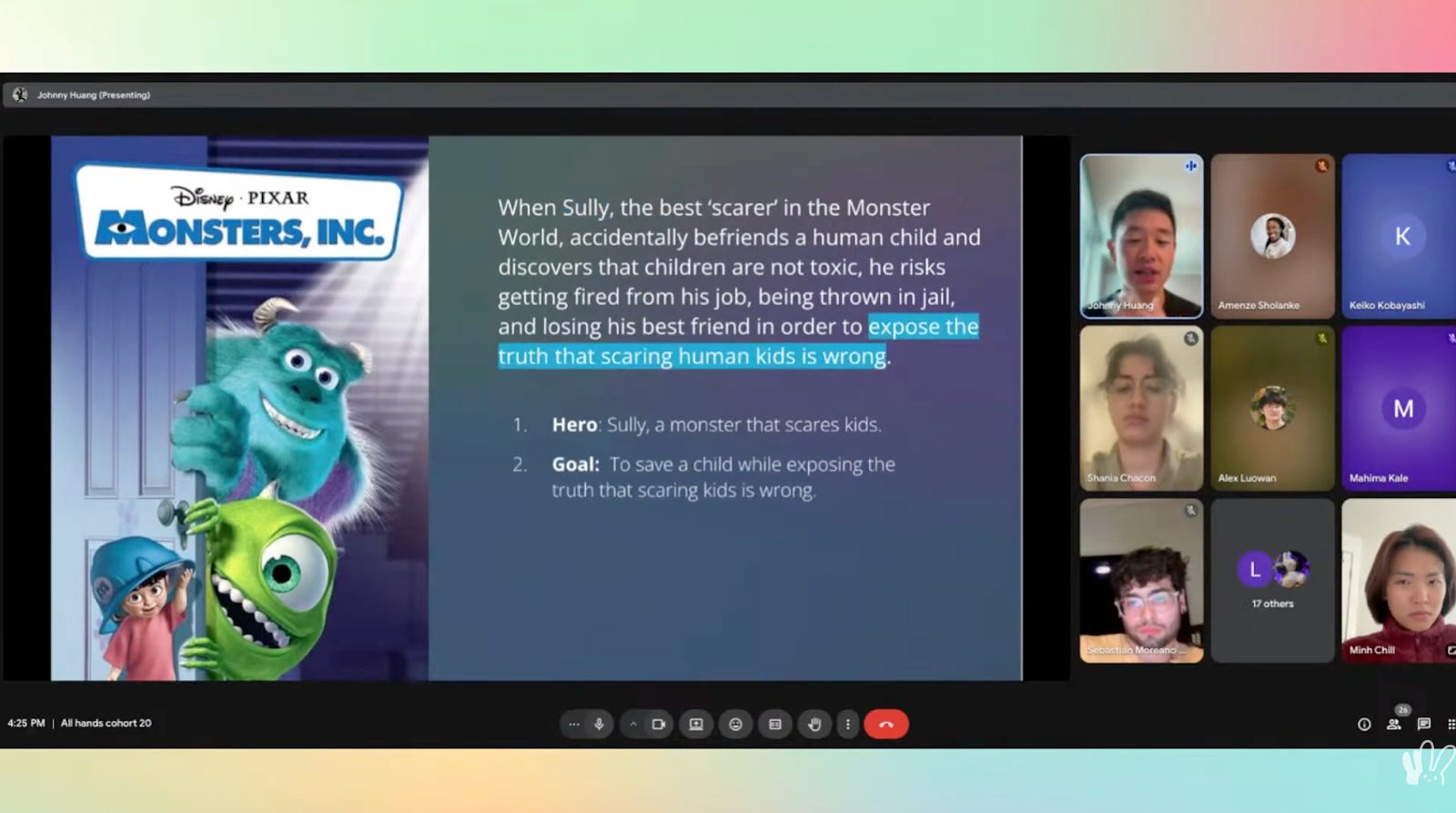
Take 1-2 of your best case studies and rewrite them using narrative structure, then practice presenting them out loud. Start with a “character” (your user) in their “normal world” (the problem). Introduce the “inciting incident” (your project’s goal). Show the “journey” (your messy design process) and the “resolution” (the final, impactful solution). Follow the famous Pixar story spine that CoCreate coach Johnny has hosted a live workshop on.
Non-technical interviewers don’t remember bullet points; they remember stories. This proves you can distill complex information into a clear, emotionally resonant narrative.
In interviews, when they ask “Tell me about a project,” you have a compelling 2-minute story ready.
5. build your own productivity tool
Identify a small, personal productivity pain point you have. Then build a real, functional utility that solves it using a vibe coding tool like Replit (get $10 Replit credits here)
This is a massive differentiator, proving that you understand technical constraints, system thinking, and how to ship something from zero to one. In an era where AI makes coding more accessible, showing you can prototype functional tools is invaluable. Plus it actually helps you in your day-to-day task ;)
Add it as a unique project in your portfolio. Write a LinkedIn post not just about the tool, but about the problem-solving process you went through to build it.
6. design an “impossible product”
Give yourself an absurd constraint, like designing an alarm clock with only one button, a weather app for people who can’t see, and etc
This is pure creative problem-solving. The goal isn’t a polished UI; it’s documenting your thought process. This is exactly what whiteboarding interviews test: how you think, how you handle constraints, and how you articulate your trade-offs.
Write it up as a “Design Exercise” or “Process Playground” piece in your portfolio. Use it as a conversation starter on LinkedIn to engage other designers and spark discussion about creative constraints.
7. perform a SWOT analysis for your dream vompany
Identify your target company. Do a deep-dive SWOT (Strengths, Weaknesses, Opportunities, Threats) analysis from a product design perspective. Then create a 1-page proposal showing how your specific skills could help them seize an opportunity or solve a threat.
This reframes you from “applicant” to “strategic partner.” It shows you have business acumen, are wildly proactive, and have thought more deeply about their company than 99% of other candidates.
Do NOT post this publicly. This is your secret weapon. Use it in your networking outreach (”I’ve been analyzing your new feature and have an idea...”) or bring it to the interview as a conversation starter.
8. conduct mock whiteboarding with an accountability friend group
Set up informal, 1-hour whiteboarding sessions with other designer friends. Use a tool like FigJam or Miro. Rotate being the “interviewer” and the “candidate.” Give each other real prompts and constructive feedback.
The only way to get good at whiteboarding is to practice. This demystifies the most nerve-wracking part of the interview process and trains you to “think aloud,” which is the real skill being tested.
This one is intended for training your design muscle. The “show off” happens when you walk into your real interview and absolutely nail the whiteboarding challenge with calm confidence.
9. commit to a 30-Day build-in-public challenge
For 30 days, share a daily learning or mini-project. Focus on a high-demand skill like learning LLM prompting for designers, building with Framer, or exploring agentic AI. Post your progress, your failures, and your “aha” moments authentically.
This demonstrates consistency, a growth mindset, and dedication while building your personal brand and network simultaneously (if you post about it).
Create a daily thread on LinkedIn or X (Twitter). The final compilation of 30 days becomes its own portfolio piece, showcasing your rapid growth and learning ability.
Events!
Online: Design feedback Fridays, every friday at 11 am pacific time on our Discord: https://discord.gg/designbuddies
We’re cohosting a DEIJ hackathon (San Francisco/hybrid on Sat Nov 15) that’s perfect for building something new, fast, while contributing to the social impact sector.
Stay tuned on our Discord for more virtual evenings coming to you soon~
Also we are co-hosting LA Creator Week, Jun 28 - Jul 3, 2026 in-person in Los Angeles! Email Grace Ling, grace@designbuddies.community if you’d like to host events here and/or sponsor
Resources!
if you’re a new designer serious about building these kinds of concrete skills to land your dream job, our Cohort 22 10-week advanced internship is accepting applications on a rolling basis.
20% off for Mobbin, the world’s largest library of real-world design inspiration! https://mobbin.com/designbuddies
Magic Patterns, new vibe coding and design prototying tool! Try it here
Podcast: How Creators Make Money!
Vibe coding with AI agents (fun short video), featuring Replit’s Agent 3! $10 free Replit credits for you to build
Event recording: Big LinkedIn Energy - How to go viral while not sounding like an NPC
🐰 About Design Buddies
Design Buddies is a community where you level up your design career. Land jobs, improve your design skills, and make friends. We have resources, events, design challenges, job boards, fun perks, and more.
👋 Visit our website and hop into our Discord community.
💖 Partner with us, or share your resources in our newsletter (email grace@designbuddies.community)
🌟 Watch our past events and connect with us on Instagram, Twitter, and LinkedIn for more fun!
👩🏻💻 Subscribe to Grace Ling’s newsletter, Grace Pace!
Got anything else you’d like to see in our newsletter and community? Please email grace@designbuddies.community