

Hi everyone! We have a guest post from Carl Wheatley (design recruiter for 10+ years at Meta & designer). We also have an exciting upcoming live talk with Carl about how YOU can get hired as a designer in the age of AI on Thu Sep 3, 1 pm pacific time, online on our Design Buddies YouTube live.
Also, Carl is a mentor on Hop, our new design mentorship & coaching platform by Design Buddies. Join us as a founding mentor (if you have 5+ years of professional design experience, you can host free, paid, and group sessions) or founding mentee! You’ll have the ability to join a secret community and influence our product
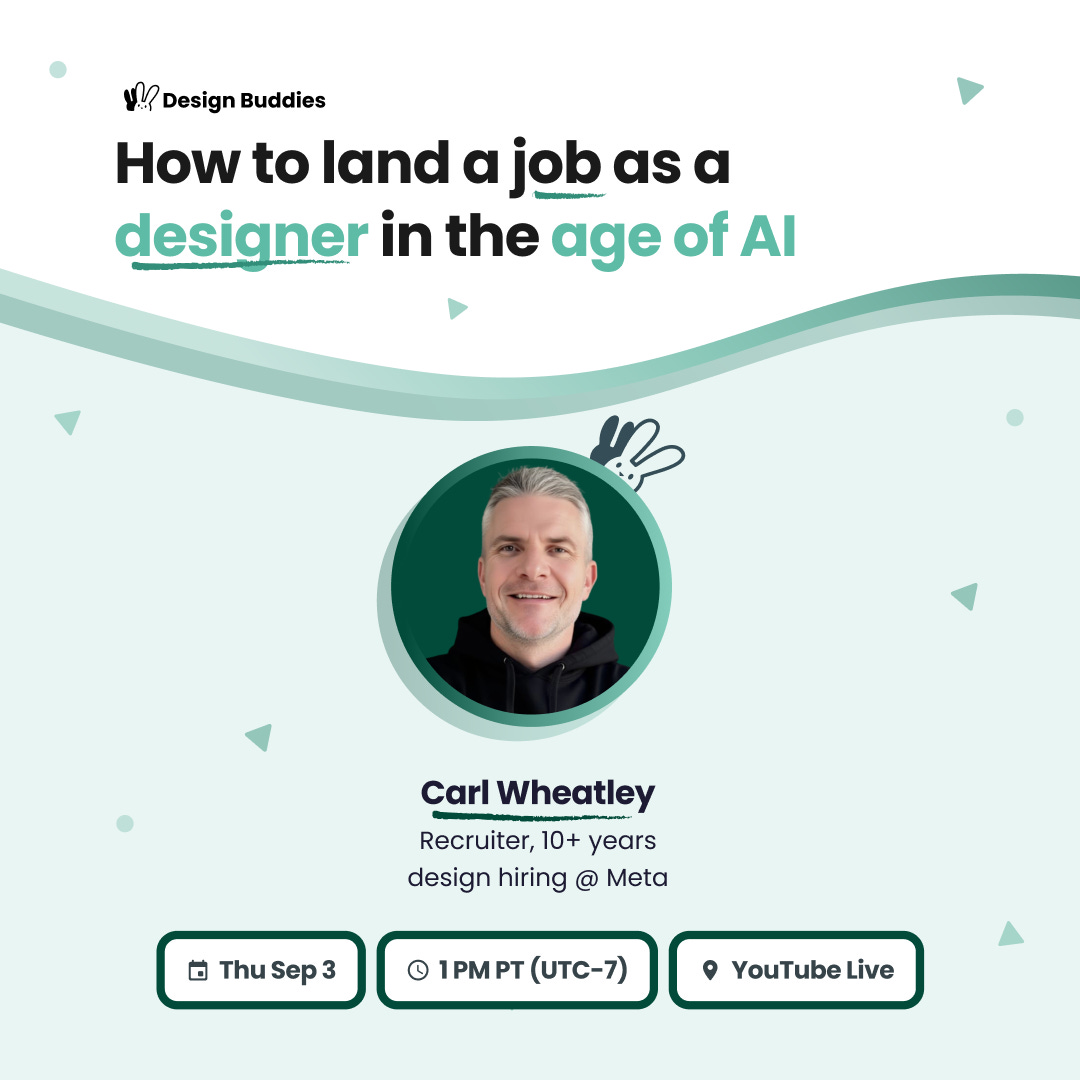
By Carl:
Here’s the story most people believe about design and AI: the tools got good enough to do the work, so the jobs are going away. It sounds simple. It’s also not true.
Design hiring is actually up. In a recent Figma survey, 82% of hiring managers said their need for designers has gone up or stayed the same over the past year, and 40% plan to open more design roles in the next six months. A VC firm called Designer Fund found design job postings across its portfolio companies rose about 60% in 2025. And Autodesk’s 2026 AI Jobs Report found that “design skills” is now the single most requested skill in AI-related job postings, ahead of coding and cloud skills.
So if demand is rising, why does it feel like things are getting harder? Because they are, just not in the way the headlines say. The bar has moved. What companies want from designers has changed. And the people who haven’t caught up are the ones struggling.
AI skills are no longer optional
Two numbers explain a lot about what companies want right now. 73% of hiring managers say they need candidates who are good with AI tools. 79% want people who can design AI products, not just use AI to speed up normal design work.
One hiring manager put it simply: “We started to factor AI into positions and hiring about a year ago, and in the last six months it has completely changed the way we hire. We fully prioritize positions that combine technical capacity, strategy, and out-of-the-box thinking.”
This isn’t about learning one more plugin. It’s about judgment. Almost every designer already uses AI. Figma found that 72% of designers use AI tools, and 98% of them are using AI more than they did a year ago. So just using AI doesn’t set you apart anymore. What sets you apart is showing you can be trusted to use it well.
Talk about your AI tools in your portfolio
If companies are hiring for AI skills, your portfolio needs to prove you have them, not just say so. A lot of designers still avoid mentioning AI, like naming the tools somehow makes the work less theirs. That thinking works against you right now. Hiring managers aren’t looking for people who avoided AI. They’re looking for people who can use it well and explain their choices. If you hide the tools you used, you’re not giving them anything to judge.
In practice, that means naming the AI tools you actually use in your day-to-day work, inside your case studies, not just as a line on your resume. Show where AI helped you move faster, where you changed what it gave you, and what you fixed. A line like “used [tool] to generate first drafts, then reworked the layout because it defaulted to a pattern that didn’t fit our users” tells a hiring manager more about how you think than ten polished final screens ever could. It also solves a problem hiring managers already have: if you’re upfront about your process, you’re not the candidate they’re worried about.
This matters even more now that AI-made portfolio pieces are getting hard to tell apart from real work. Being open and specific about how you use AI isn’t something to hide. It’s one of the easiest ways to stand out as someone worth trusting.
This applies to how you build the portfolio itself, too. You can design it in Figma, Make, or Claude Code. But there’s no shame in using a Webflow or Framer template either. What matters is the thinking inside it, not whether you built the site from scratch.
The rise of the Design Engineer
If you want to see where the market is placing its bets, look at who’s actually getting hired at the companies leading the pack. Vercel has written a whole manifesto about it. Stripe built dedicated teams around it. Cursor’s job listing describes someone who “lives at the intersection of design and code.” And a16z launched a Design Engineer Fellowship looking for designers who, in their words, have “absorbed engineering into their craft.”
Julie Zhuo has said the market for startup design talent has never been more competitive. What founders actually want, as designer Carly Ayres puts it, are “Super ICs”: senior people who can move across product strategy, design, and engineering, and build things themselves when needed. The lines between roles are blurring both ways. Figma found the number of designers doing development work doubled to 41% in the past year, while the number of developers doing design work rose from 44% to 60%.
This isn’t a niche job title anymore. It’s becoming the standard hire at the companies that matter most.
Junior designers are stuck
Here’s the part of this story that doesn’t have a clean answer, and it shouldn’t. A Harvard study that looked at 62 million workers found junior hiring dropped 8 to 10% at companies that started using generative AI, mostly because those companies quietly stopped opening junior roles rather than laying anyone off. A separate PwC study of over a billion job postings found entry-level roles in AI-heavy fields now ask for skills that used to only show up later in someone’s career, things like judgment and stakeholder management.
The reason is simple once you see it. Junior design work used to mean repetitive tasks: cropping images, resizing files, making banner variations, doing first drafts of case studies. That’s exactly the kind of work AI now does in seconds. The bottom rungs of the career ladder didn’t disappear. They got automated away from the people who needed them to climb up.
Recent college graduate unemployment hit 5.7% at the end of 2025, higher than the national average. That’s a real shift, since new grads used to do better than the overall job market, not worse. Junior UX and UI job postings are reportedly getting 500 to 800 applicants each, and more than 90% of junior portfolios look nearly the same, because most beginners are taught the same templates.
There’s no tidy answer here yet. How do you become a senior designer if it’s harder than ever to get a junior job in the first place? That’s a real problem the industry hasn’t solved.
Hiring is harder to trust right now
This is the part of the AI story almost nobody talks about, because most people write about this from the job seeker’s side. From the hiring side, AI hasn’t just changed what companies want. It’s changed whether they can trust what they’re looking at.
One study looked at 19,368 live interviews between July 2025 and January 2026 and found 38.5% of candidates were flagged for using AI to cheat, a number that tripled in three months. For technical roles, it hit 48%. Even more telling, 61% of the candidates flagged for cheating still passed. The people who got away with it often looked like the strongest applicants on paper. 72% of recruiters say they’ve already run into fake resumes, portfolios, or credentials made with AI, and there are real cases of candidates submitting AI-made project work they couldn’t explain when asked.
Only 19% of hiring managers feel very confident their current process would catch someone faking it. The take-home design test, long the standard way to check real skill, is losing its usefulness fast.
The fix people are landing on isn’t better detection software. It’s changing the process so it doesn’t matter whether someone used AI to prepare. Think paid trial projects on real, slightly messy problems. Live conversations where a candidate walks you through their own thinking. Interviews that test how someone thinks, not just what they turn in. And it’s worth being fair here: using AI to prepare for an interview is not the same as getting fed answers live during one. The real question isn’t whether a candidate touched AI. It’s whether your process tests their thinking or just their output.
What this all means
Design hiring in 2026 isn’t shrinking. It’s sorting people out. Companies are paying more for designers who can direct AI well, not just keep up with it. Judgment is becoming the real skill companies are buying. And the hiring process itself has to work harder to tell who actually has that judgment. None of this is a reason to panic. It’s a reason to get specific about what you’re actually good at, and to work with people on the other side of the table who are testing for the real thing.
Resources
Online event: Design feedback Fridays, every friday at 11 am pacific time on our Discord
One month free Granola meeting notes (favorite meeting notes app)
One month free Wonder design tool, use code DB2026. Generate designs with the latest models, edit with Figma-level precision, and connect your code context all on the same canvas.
20% off for Mobbin, the world’s largest library of real-world design inspiration! https://mobbin.com/designbuddies
$10 free Replit credits for you to build + new designer mode launched
🐰 About Design Buddies
Design Buddies is a community where you level up your design career. Land jobs, improve your design skills, and make friends. We have resources, events, design challenges, job boards, fun perks, and more.
👋 Visit our website and hop into our Discord community.
🐰 Join Hop, our new design mentorship & coaching platform as a mentor or mentee
💖 Partner with us, or share your resources in our newsletter (email grace@designbuddies.community)
🌟 Watch our past events and connect with us on Instagram, Twitter, and LinkedIn for more fun!
Got anything else you’d like to see in our newsletter and community? Please email grace@designbuddies.community
Mal barré pour obtenir ce qu'on voudra réellement….il va falloir faire des croquis assez fignolé et un bon prompt. Sinon il y aura beaucoup d'interprétation. Ça permettra peut-être d'aller plus vite, mais il y a des comportements de l’ia qui peuvent être gênant….j'aimerais bien voir la réalisation d'un plan d'architecture côté par IA.